
Posted by United Survival on Jun 16th 2024
Safe Water When Disaster Strikes
State of Nature
We understand dangerous weather affects all Americans and everyone around the world. May 2024 greeted the southern part of the United States with flooding, wind, and hail. For instance, these dangerous forces ravaged Texas residents in and around major cities like Dallas and Houston. In both cities, hurricane-force wind gusts downed power lines, branches, and trees that blocked roads where flash flooding didn’t already threaten lives. Hundreds of people in Houston needed to be evacuated from their homes while thousands of others suffered in the heat for days without electricity. Cooling centers were set up and volunteers helped deliver needed supplies. In fact, the recent storms were so severe that there were over 500,000 power outages across North Texas over Memorial Day weekend–200,000 in Dallas County alone. These storms extended north into Oklahoma and east as far as Florida and caused damage in the states in between. Storms and flooding pose a significant threat to life on their own, but when the winds die down and the waters begin to recede, a new set of risks will also endanger a community just trying to rebuild itself.
Water Before and After
Power outages tend to be associated with thunderstorms, hurricanes, and tornadoes, but–by themselves–do not necessarily endanger water sources, especially city water sources, but flooding can contaminate both urban water sources and domestic wells. This is a real danger to people. The water before a dangerous weather event was safe and trustworthy, kept pure by water treatment plants or just unaffected in wells; however, following a severe weather event, the water cannot be trusted. It is almost certain that it has harmful microbes and toxic chemicals in the water. Following a storm, urban water purification systems can be overwhelmed or compromised, just as well-water may be contaminated due to inundation or worse–submerged.
Urban Water Sources
Public drinking water systems prevent impurities from affecting people. Firstly, they eliminate microorganisms that cause disease. Yet, floods increase the number of coliforms, indicators of fecal contamination, such as E. coli, in public water sources, which pose a major health risk for residents. In areas with commercial animal operations, risks for microorganisms increased. For instance, following Hurricane Florence in 2018, elevated amounts of E. Coli were discovered because of a commercial hog operation.
Studies have demonstrated that chemical contaminants are also a significant concern. It’s important to remember that roads, vehicles, construction sites, and a host of other sources of chemicals spread easily with flooding. Surface waters can be contaminated with gasoline and oil. Less visibly though, substances such as nitrates, arsenic, barium, copper, iron, lead, manganese, nickel, and zinc are often found in magnitudes of higher concentrations following a flood event. Studies on the impact of 2005 Hurricane Katrina in New Orleans and the 2011 Ohio River flooding in Kentucky, both demonstrated increased amounts of lead, arsenic, nickel, copper, zinc, and nitrates. The exact amounts of each pollutant differed in each case, but they demonstrated the concern residents should maintain. One aspect that increases concern is that floodplains tend to have heavy metal pollutants and flooding only spreads them to residential areas.
Well Water Sources
Private rural wells can be easily compromised by flood waters. A study of wells following 2017’s Hurricane Harvey produced surprising results–rural wells were submerged more than urban. They also discovered that, in the aftermath of Hurricane Harvey, even within 100 meters of the inundation residents were twice as likely to be contaminated. Other microbial contaminations increased dramatically within 100-250 meters as well. Overall, the study concluded that all coliform occurrence was 1.5 times higher than the baseline while Escherichia coli was 2.8 times higher over the baseline. What’s also notable is that rural wells tended to have a higher percentage of microbial impurities.
Wells are also subject to chemical exposure from flooding. As previously mentioned, floodplains tend to have heavy metal pollutants, but chemical pesticides from farming communities present dangers as well. It should also be remembered that private wells are not covered by the Safe Drinking Water Act, which is the main law that ensures safe public drinking water by establishing maximum contaminant levels along with water treatment requirements.
What Can You Do?
Public water sources use several methods to make water safe to drink, including chemical sanitization, but during a natural disaster, this kind of infrastructure is not available or may even be compromised. Thus, to address these serious health concerns, there are a few methods to ensure that your water is clean.
Boil The Water
Boiling water is one of the most basic ways to sanitize your drinking water and has contributed greatly to the state of overall health around the world. It eliminates non-thermotolerant coliforms and typical pathogens. It even reduces the concentration of some chemicals, such as bromate and chloroform. Overall, it’s the most widely recommended form of water purification and the first line of defense against unsafe drinking water. Yet, it’s important to consider its limitations as well. CDC recommendations include a reminder that boiling does not eliminate all harmful substances. For example, boiling water will not affect fuel or toxic chemicals like chlorine and lead. While the threat from potentially harmful microorganisms can be alleviated in this process, its limitations present challenges during a natural disaster.
Filter the Water
Filtering removes solids or other substances. To start with, the basic filter available to most people will be coffee filters. This is a readily available tool to strain out solid matter. Similarly, hollow fiber filters, made of thin, semi-porous cellulose or synthetic polymers, efficiently filter solids, and even pathogens, through hundreds of tiny tubes that trap them. Next, sand, zeolite, and activated charcoal are effective layers for any filtration process because they block solids, trap pathogens, and even absorb chemicals. Lastly, filtration bottles and systems are available for purchase, but not all provide an equal service. Usually, to get the water as pure as possible, it’s best to combine different layers of filtration methods.
Purify the Water
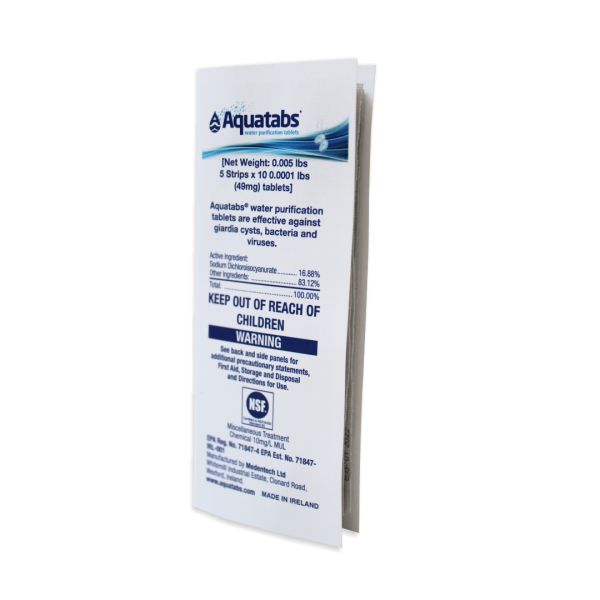
One way to sterilize the water during an emergency is to use purification tabs. The United States Army first used iodine purification tabs in 1952, and ever since their use has become standard for providing emergency potable water. Today, these tabs are either iodine or chlorine-based, which are released from a larger compound. As the chemicals activate, they render bacteria, viruses, and harmful protozoans inert and safe to consume. Different brands have different shelf lives, but, on the whole, they can last years before they are no longer effective. A residual chlorine taste may be in the potable water.

Take Action
Currently, According to the National Oceanographic and Atmospheric Administrations, the United States is under what is considered ENSO-neutral conditions, a period between both El Nino and La Niña, but there is a 65% chance of a transition into La Niña from July to September and an 85% chance that La Niña will continue through the winter. Now is the best time to prepare for these dramatic weather patterns.
United Survival has several items to address your safety needs when weather turns ugly. The Pathfinder canteen set is a fantastic choice for boiling water. The Pathfinder Canteen Cooking set includes a wide-mouth military canteen that can withstand fire and hot coals to boil water. Understanding the limitations of boiling water, we provide for filtration needs too. The Sim Pure Water Filter Bottle boasts hollow fiber technology, and the Water Filter Straw has a five-stage water filtration system made of strong, chemical-resistant High-Density Polyethylene and a non-toxic thermoplastic called Acrylonitrile Butadiene Styrene. In addition to boiling and filtration products, United Survival offers Aquatab– which is effective against viruses, bacteria, and Giardia cysts. These troclosene sodium tablets provide a slow release of chlorine that provides safe drinking water in thirty minutes.
Overall, safety is always the number one priority, and United Survival is here to help families prepare for the worst that nature has to offer.
Works Cited
https://www.pbs.org/newshour/nation/power-expected...
https://repository.lib.ncsu.edu/items/812eb8b0-ad1...
https://www.epa.gov/privatewells/potential-well-wa...
Microbial and chemical contamination during and after flooding in the Ohio River—Kentucky, 2011 https://stacks.cdc.gov/view/cdc/48964
https://www.ncbi.nlm.nih.gov/pmc/articles/PMC20164...